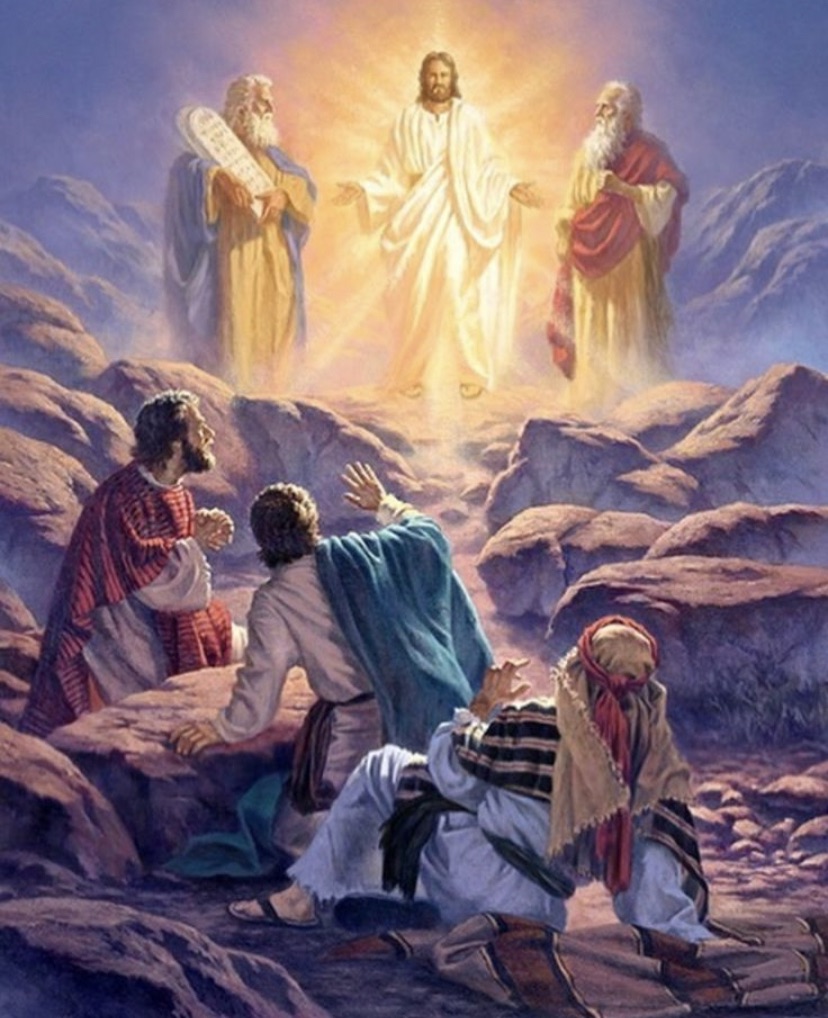
The episode of the Transfiguration accompanies us to discover the identity of Jesus.
A few verses earlier, in Cesarea Philippi, Jesus asked to his disciples, “Who do people say I am?”. An the disciples told him, “John the Baptist, others Elijah, others again, one of the prophets” (8:27-28). We know that after this Peter spoke up and said: “You are the Christ” (8:29) but when Jesus announced his Passion (and Resurrection) Peter resisted that and rebuked Jesus and Jesus told him to step back and occupy the position of the disciple.
Recalling the dynamics of what comes before helps us to understand the dynamics of the episode narrated in today’s Gospel.
Jesus took with him Peter and James and John and led them up a high mountain… There in their presence he was transfigured: his clothes became dazzlingly white, whiter than any earthly bleacher could make them White is the colour of light, is the colour of God, of what’s divine… We may say that from the inside of Jesus, a light gushes out and overflows towards the outside and captures even the fabric of his clothes…
Elijah appeared to them with Moses; and they were talking with Jesus. Elijah and Moses. Both experienced God’s revelation on a mountain; both exercised a leadership role among the people which exposed them to criticism, persecution and suffering; finally, the place of the tomb of neither of them has been found, so that the Bible itself tells of Elijah’s being taken up to heaven in a chariot of fire, while the Jewish tradition tells of Moses’ being also taken up to heaven…
We have the impression that Peter, James and John cannot hear the content of the conversation. We can imagine that they are talking about the imminent passion of Jesus, who will suffer a martyr’s death like so many prophets before him.

Then Peter spoke to Jesus: ‘Rabbi,’ he said ‘it is wonderful for us to be here; so let us make three tents, one for you, one for Moses and one for Elijah.’
He did not know what to say; they were so frightened. Peter’s proposal is inspired by fear and the narrator qualifies it as improper.
First of all, he addresses Jesus as Rabbi, Master, which seems inappropriate in the context of a scene that highlights Jesus’ close association with the divine sphere.
He emphasises that it is beautiful to be here, forgetting that the role of the disciple is not only to be here but also to be sent, to be on the way…
He also suggests the construction of three tents, perhaps with the idea that they could be used as dwellings because they will stay on the mountain for 40 days like Moses?
Listing the names, he does not adequately grasp the relationship that exists between the three characters: perhaps he puts them on the same level or, by naming Jesus first, then Moses and finally Elijah, he puts Moses in the centre (as if mentally depicting a triptych with Moses in the centre and Jesus and Elijah on the sides, in a subordinate position).
I underline all this to say that Peter’s misunderstanding continues, as in the episode at Caesarea Philippi. It is not enough to say “You are the Christ” to claim to have grasped the identity of Jesus.
And a cloud came, covering them in shadow; and there came a voice from the cloud, ‘This is my Son, the Beloved. Listen to him.’
It now seems that the cloud hides the three characters, so that the disciples no longer see anything, but only hear.
The voice tells the disciples to listen to Jesus, to fix their attention exclusively on him. With this we understand how Jesus cannot be identified with one of the prophets and his identity goes far beyond that of Elijah and even beyond that of Moses.
Who, then, is Jesus? The whiteness of the garments manifested his divinity and the voice declares it “This is my Son, the Beloved”. These words in the scene of the Baptism at the Jordan were addressed only to Jesus (“You are my Son, the Beloved”). Now the disciples hear them for the first time …
Then suddenly, when they looked round, they saw no one with them any more but only Jesus.
At this point, when the voice is silent, the cloud dissolves. Moses and Elijah are no longer there. There is only Jesus… Someone translates “the usual Jesus”, dressed in his usual/ ordinary garments…
And coming down from the mountain Jesus again refers to himself as “the Son of Man” who will have to know death and then rise from the dead …
It is in Him that we must recognise the mystery of light contemplated on the mountain, it is in the “usual Jesus”, in the ordinary Jesus… in the Son of Man that we are called to recognise the “beloved Son of the Father”… the one who – as a true Son of His Father – behaves as He behaves, reasons as He reasons, loves as He loves, to the point of giving His life, of loving with a love that is tenacious and stronger than death itself!
 Temple Ministries
Leave a comment